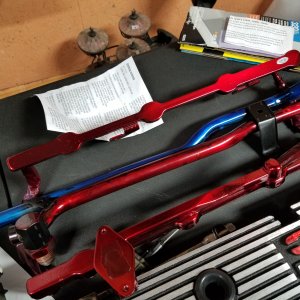
Got the second refurbished LR caliper on, all four new rotors, new rear pads, already had new front pads from a couple of weeks ago, and both brand new front calipers. It took forever, especially like two or three hours of fiddling with the front metal brake pad hardware shims so they wouldn't contact the rotors, on the front left more than the right. I don't think it's just from the rotors and pads being new; that's what they're designed and measured around. Then again, they're not precision machined. I have like three baggies of them now. It's possible that if I can find some washers big enough to fit around the caliper bracket bolts (or make some out of a couple of coins) I could offset it by a like a millimeter so the shim isn't touching the rotor. I checked repeadly to make sure the shims and ABS sensor weren't touching anything. The pads ofc were touching during testing, even with trying to pry them off the rotor to get as much space when the pistons are released as possible. There's just not any mechanical component that is pulling the pads off the rotor--it doesn't exist on the lower end calipers. Maybe it does on the $2500 redesigned calipers, but all the regular OEM style ones don't have anything forcing the pads to not just scrape the rotors after braking. One the OEM version, the pistons move the caliper and inside pad only, but even the inside pad isn't locked down onto the pistons. So I took the car for a test drive around the block a few times with an assistant in the passenger seat, and I hear a noise that sounds like it's metal on metal coming from one of the right side calipers, not pads on the rotors. My assistant couldn't hear it above the engine noise, but I could hear it when passing slowly next to parked cars. It increases slightly in volume with and is an uneven cyclical noise. Tomorrow, I'll have to put it back on the stands again and check on the right front and maybe the right rear caliper. It almost sounds like it's the right rear one, but that's hard to tell. I only changed out the rotors on the right rear one, and had checked to make sure the shims weren't scraping. I predict that I'm going to end up taking the tires off, inspecting it, and finding that everything looks fine and there's no contact, so if there's smth I can do to anticipate that problem, let me know now.
Before the test drive, I purged and bled all four corners twice, bc it wouldn't build pressure. Put ptfe tape *and* grease on the bleeder screws, purged and bled them all over again. Got pressure. Pedal pressure felt solid with the key in ignition position. With engine started and driving around, it felt mushier than that, but still not as bad as a couple of weeks ago.
Before the test drive, I cleared the ABS codes, turned off car, took the key out, waited a few seconds, started the car back up, got the ABS codes immediately. I also swapped the position of the two rear wheels. That suggests to me that it's maybe the wiring or some module or smth.
I'd been checking to make sure there were zero leaks during the bleeding. After the test drive, I noticed the right rear banjo bolt appeared to have a few drops of brake fluid on it. I'd already tightened it down to the 30 ft lb torque specified by the shop manual when I replaced it a month ago. It's probably at like 40 ft lbs now. I didn't and don't want to over-tighten it. It still leaked after that, so I tighted it gradually a bit at a time until it stopped leaking during bleeding. I'm leary of tightening it more, but I don't think 45 ft lbs is going to ruin it. That's what I've got the front banjo bolts set to. It has new washers. If it keeps leaking after that, I'll have to take it out and see if ptfe tape will help it any. Idk how long ptfe tape resists brake fluid, though, bc if it eats through the tape I'm back at the start and probably won't find out that it's been leaking again until it's already been doing it for like weeks.