
Engine Cooling

cobrajeff96

Well-Known Member
SN95 Supporter
Joined
Feb 1, 2022
Messages
2,951
Reaction score
2,952
Location
Germany
Request Sticky so that we can build it up over time.

There's been plenty of talk this year about cooling an SN95, especially with this hot summer in many places.

This can be a store of helpful info. Remember always that boiling coolant is dangerous for both you and the car and to never rapidly depressurize a radiator or expansion tank. Boiling coolant will most likely damage a motor, especially the interface between the block and heads. Even if the motor is lucky and no damage occurs, steam pockets within an overloaded cooling system act as perfect insulators, trapping heat in various places inside the coolant passages. This can give temp sensors faulty readings and make chasing air pockets out of a motor very difficult unless it's a modern expansion tank design that self-bleeds, like the Coyote in its stock form.

If anyone has any handy info to supplement this with, by all means feel free. Attached is a helpful image I found that can hopefully dis-spell some of the myths out there regarding safe operating temps and thresholds.

Boiling Point Matrix (pressure vs coolant mix).JPG
 

dsrtjeeper

Active Member
Joined
May 28, 2015
Messages
399
Reaction score
145
One big tip is to not rely on the factory temp gauge.

If you suspect that your engine is overheating but the temp gauge, whether stock or aftermarket, is reading fine or low...pull over and shut it down. A temp sender cannot accurately read steam.
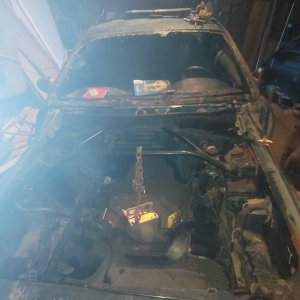
This is what happens when you blow a freeze plug and lose all coolant.
 

dsrtjeeper

Active Member
Joined
May 28, 2015
Messages
399
Reaction score
145
My recipe for a cool running engine in extreme heat:

High flow water pump.

High flow T-stat (at least 180°) I use the Robertshaw brand.

Lower radiator hose with an internal spring LMR carries these.

Dual electric fans (Summit sells dual SPAL 11" fans mounted in a shroud) These fans really sing. The dual Ford Contour fans work well also.

I use rubber gasket material to seal the fan to the radiator core.

Warmer climates or even just for the summer coolant mix- 100% distilled water with the appropriate amount of Royal Purple " Purple Ice".
I no longer use Water Wetter due to the slime that it leaves in the coolant system. If you Google it, you'll see that it's pretty common.

Depending on your climate, you may or may not need an aftermarket radiator. I'm currently using a Mishimoto in Phoenix. I suspect that a Dewitt's or Cold Case would be a bit better.

In 1997, Ford put out a TSB for the '96 GT cars that were overheating. The fix included a newer designed '97 GT A/C condenser. This condenser has less fins per inch thus allowing much better airflow to the radiator. The only mod needed is slightly bending one of the tubes coming out of the upper passenger side of the condenser. This aligns that tube with the appropriate coolant hose.

Do not remove the rubber gasket on the cowl that seals against the hood. It's there to retain the high pressure/low pressure zones.

The following must be in place:

The lower air dam that attached to the bottom of the radiator core support.

The vertical rubber seals that sit between the condenser and radiator. There's one on the left and right sides.

The plastic vertical air deflectors that mount on either side of the condenser and protrude into the bumper cover. These direct the airflow through the condenser and radiator.

The plastic radiator cover in the engine bay that has "MUSTANG" stamped in it. This directs airflow as well.

Lower fan ON/OFF speeds in the tune or with a fan controller.

Use battery power to power the fans with 12awg - 10awg wire. You can get fan power from the big (+) lug on the side of the fuse box.
Use a heavy duty circuit breaker or inline fuse/fuses with the fan (+) wire/wires.
Use heavy duty 40amp relays when wiring the fan/fans. You need a separate 40 amp relay for each fan.

Dual SPAL fans:

PXL_20260901_182954313.jpg

Circuit breaker with red rest button:

PXL_20260901_183112497.PORTRAIT.jpg

Side defectors on each side of condenser:

PXL_20260901_183422998.jpg

PXL_20260901_182849369.PORTRAIT.jpg

Air dam under radiator core support:

PXL_20260901_183255997.PORTRAIT.jpg

Radiator cover:

PXL_20260901_182927217.PORTRAIT.jpg

Rubber seal in-between radiator and fan shroud:

PXL_20260901_183201663.PORTRAIT.jpg

Condenser lines:


PXL_20260901_183136286.PORTRAIT.jpg

PXL_20260901_183126041.PORTRAIT.jpg

'97 condenser core:

PXL_20260901_183318583.jpg
 

shovel

Active Member
Joined
Jan 4, 2023
Messages
715
Reaction score
658
I'll contribute a couple things to this.

First thing is on coolant chemistry - my education was not in chemistry so I'm going to stick to what I know however this is still important enough to talk about. Standard coolant/antifreeze is a consumable like motor oil. The salts in it are engineered to take up free ions so the various metals in contact with the coolant don't eat each other. The scale or "dust" you find inside coolant pipes is those captured ions and salts falling out of suspension. That's a bit of an insulator, like pure bare aluminum can transfer about 400x as much heat energy as calcium carbonate (scale from hard water) . That is why it's a good idea not to use hose water in your coolant system especially if you live somewhere with hard water. Hard water uses up the sacrificial salts and it deposits a jacket of insulation all throughout your coolant system.

The part that exceeds my education and also gets debated a lot is whether to use ionized water or deionized or distilled water, or softened water, or whatever specific flavor of water to use. For me personally I just buy premixed coolant and let the guys at Prestone figure out water chemistry for me it's not worth the 10 dollars I might save every 5 years trying to outsmart them mixing my own.

Second thing is just a reality check we should be doing with any modification or troubleshooting step no matter what car we're working on: The car left the factory stable, reliable and (for its time) relatively safe to drive. It did not overheat when it was new. Even if your engine now makes 700 horsepower the amount of energy it takes to push a 3500 pound car with about 20 square feet of frontal area through the air did not meaningfully change so your net fuel consumption and gross heat production should not be very different from stock while driving on the street.

Racing is different, it takes a lot of fuel to make twice or three times as much power and there's a reason a Veyron has three engine coolant radiators plus a dry engine oil radiator. But you're not asking your 700hp car for 700hp to go 60mph on the freeway it's making the same 25ish horsepower to overcome aero drag, rolling resistance and accessory drive that it would stock... maybe just a little extra to turn a supercharger or work a heavier set of valve springs but that's not a lot at cruise.

The reason that reality check is a good tool to keep in your mind is that if you're chasing down a temperature problem at idle or moving through traffic it doesn't really matter how much horsepower your car makes - you can unburden yourself of just assuming it's about the power. So you can start tracking down what it really is. Is your car so low that the air which comes in the radiator has nowhere to go? Is there an intercooler blocking half the air? Is that cover over the radiator missing so air is just going over the top and bypassing the core of the radiator? Do you have a cheap aftermarket fan that only draws 15 amps and wouldn't disturb a dandelion? Is your DOHC Coyote or twin turbo setup blocking all the air flow through the engine bay? Is it just that your turbo is making the heat in the exhaust stick around longer in the engine bay with more surface to radiate it from?

Take away the excuse that it's just because moar powar and you can think clearly about what mechanism is causing your overheating problem.

Bonus topic: your typical thermostat works by melting a little plug of wax and that pushes a plunger out that opens the gate and allows coolant to pass. Hopefully it's obvious that means the mechanism needs to be installed on the engine side of the thermostat or it's going to take a whole lot longer to begin opening, but also take note that if your engine overheats enough it's possible for some of that wax to get expelled past the plunger and that will mean the thermostat doesn't open as far the next time.

There are also "failsafe" thermostats that have little ratchet pawls which will catch the gate if it is pushed past a predetermined aperture, preventing it from closing again. Whether you get a failsafe style thermostat or a conventional one they're both "spent" after overheating and will need to be replaced, but you can hopefully understand the utility of the failsafe ones. The drawback on them other than being trivially more expensive to buy is they usually have a smaller gate than a performance thermostat because the pawl mechanism takes up a little room on the main stamping. What you do with that info is up to you, unless somebody's doing a bunch of CFD work on the cooling system a lot of the justification for a large aperture thermostat would have to come down to feels.
 
OP
OP
cobrajeff96

cobrajeff96

Well-Known Member
SN95 Supporter
Joined
Feb 1, 2022
Messages
2,951
Reaction score
2,952
Location
Germany
I'm the same as far as pre-mixed. I trust the big names to get it right, and I'm not hardcore enough to go pure water as in race-only car. That said, distilled water would be the only way to go in my mind, as anything else might introduce electrolysis into the mix which accelerates degradation. On that note, another attachment...
 

Attachments

  • Coolant Electrolysis Test.pdf
    21.6 KB · Views: 1

dsrtjeeper

Active Member
Joined
May 28, 2015
Messages
399
Reaction score
145
You don't have to be hardcore to run straight water. You just need to live in AZ or Vegas. We defy all physics here. Lol!
 

Latest posts

Forum statistics

Threads
78,764
Messages
1,540,520
Members
16,261
Latest member
nynce

Members online

Top