
(Turbo) Crankcase Ventilation is Important (i.e. my experience with an Amazon catch can)

garrittpwl

Active Member
Joined
May 15, 2016
Messages
315
Reaction score
339
Location
Indiana
Thought I'd share a discovery that I've had recently for those that don't really think about it or just don't know. Its obvious now that I've learned it but no one comes out directly and says "hey, make sure of this because of this" so lets get to it.

Why is a a catch can important specifically when using running a turbo?

If you're unfamiliar with turbo setups, they require oil (well most, some new fancy ones dont). That oil has to be pumped into the turbo via a feed line, then regulated to a pressure that the turbo can handle and then evacuated via a drain line to the oil pan.

Turbos lower than the oil pan require a scavenger pump to pull the oil from the turbo to the oil pan. Turbos higher than the oil pan can gravity feed back to the pan provided its a steep, smooth straight line.

Now lets get to the point. Since I slapped an on3 kit on my car last summer, I've always had a little smoke at the stop lights here and there. Nothing that a few blips of the throttle couldnt clean up. I equated this to a cheap chinese turbo seal. What I discovered was that in actuality my turbo was not draining efficiently. But wait?! I did everything correct, ran a nice -10 AN line from the turbo with a smooth turn right into the top of the oil pan right?

WRONG!!!! I used an amazon catch can with a vent that was only 3/8 in diameter! So my vent system from the crank case had TWO -8AN lines running to the can and then a single 3/8 vent to atmosphere.

I found that since the crank had such a small vent. I was creating a positive pressure inside the engine, very small but still positive. That pressure would slow the oil in the turbo's drain just enough that it would enventually (long cruises for example) not allow the turbo to drain properly and oil would seep around the seal on the exhaust turbine side. This in turn caused it to smoke!

I watched a video about diesel guys having the same issue, though now it seems common sense. Basically like trying to empty or fill a gas can that doesnt vent properly.

Seems silly but I thought I'd put some info out there in case someone in the future was trying to diag their turbo smoking.

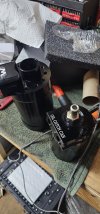
Below I attached a picture of my newly acquired motion raceworks catch can vs the amazon one I was attempting to use. Now I know why they're 200 bucks instead of 30.....

1000002373.jpg
 

tvsn95

Member
Joined
Feb 9, 2020
Messages
166
Reaction score
72
Let me pass on my experience. I have built several turbo/supercharged, including On3.
First a -10 drain is TOO small, you can get a full 5/8" ID drain on the turbo that will then take a 3/4ID hose, I like an extended tube to get away from the high turbine heat. ( no fires), I have made my own. this stops the smoking and leaking problems.
I build my catch cans from PVC, this works well to figure out what you need . then you can build it from better materials.
I also use a GM air injection pump, used in 1990s cars to suck from the original PCV location and blow to the catch can. this is activated with a watts switch to come on at the slightest press.
I have used this for years now.
 

cobrajeff96

Well-Known Member
Joined
Feb 1, 2022
Messages
2,827
Reaction score
2,868
Location
Germany
Were you using a single catch can for that time period? I wonder if one can per bank would've made it a non-issue if that's the case. Then again a boosted setup will always require more ventilation than N/A. Maybe even twin 3/8 vents might not be enough but it's experimentation by the time boost comes into question.

I myself (Coyote N/A) run twin fully baffled cans, 12AN from valve covers to the cans but then 10AN on suction side to their normal places (closed system just like factory).
 

Attachments

  • 20210629_142428.jpg
    20210629_142428.jpg
    262.4 KB · Views: 9
  • 20230413_121437.jpg
    20230413_121437.jpg
    268.7 KB · Views: 9
  • 20230310_142654.jpg
    20230310_142654.jpg
    242.3 KB · Views: 10
OP
OP
garrittpwl

garrittpwl

Active Member
Joined
May 15, 2016
Messages
315
Reaction score
339
Location
Indiana
Were you using a single catch can for that time period? I wonder if one can per bank would've made it a non-issue if that's the case. Then again a boosted setup will always require more ventilation than N/A. Maybe even twin 3/8 vents might not be enough but it's experimentation by the time boost comes into question.

I myself (Coyote N/A) run twin fully baffled cans, 12AN from valve covers to the cans but then 10AN on suction side to their normal places (closed system just like factory).
I was using a single catch can. One per bank might have made it better. I kept the -8 lines that was running and ran them over to the new motion catch can. Drove 200 miles Saturday with no issues.
 

cobrajeff96

Well-Known Member
Joined
Feb 1, 2022
Messages
2,827
Reaction score
2,868
Location
Germany
Yea, 8AN can move a decent amount. Probably best to increase that to at least 10AN since boost, just my opinion. Again though it's one of those trial by error things. If 8AN over time fits the bill then it's good.
 

TTSaleen

Active Member
Joined
Aug 12, 2011
Messages
896
Reaction score
746
Location
NC
I run 10AN lines from each valve cover to a 12AN Adapter into my Moroso catch can.
Here's the can I use.

It helps alleviate the pressure in the engine (especially under boost), but it also serves a nice double duty of separating the water content running my E85.
I drain it after each drive and always get a small amount of water out of it.

Ryan
 

MachSVT

New Member
Joined
Dec 4, 2024
Messages
43
Reaction score
25
I'll try and update this late to show my seup on an Eaton swapped car, but overall I can verbally illustrate for now...

I have two -10 lines off my valve cover into oil seperators. The "fresh air" (pasenger) side is after the mass air meter (this is a very important note - if running speed density, no concern). Keep in mind that any air introduced to an engine (intake AND crankcase) must be accounted for if plumbing back to the intake in your crankcase evacuation setup. It is extrememly important to be certain you have no leaks, as it will throw off your fueling due to unmeasured intake air.

Due to vacum being pulled on the drivers side valvecover from the supercharger (pre-rotor pack), you have a cross-flow effect on the crankcase, which helps to scavange out blowby contaminents, as well as pressure. The issue being experienced in the OP's setup ALSO means that your oil dranback from the cylinder heads to the pan is being negatively impacted. Carrying too much oil in the cylinder heads can lead to more serious problems.

Lastly, if for any reason both -10 lines are overwhelmed with excess pressure, I also have this (Note: be sure to look up the correct applicable part!) which acts as both a free vent filter AND a PCV, as it has a large check ball in the baffle. This is mportant in my setup as it allows the system to pull vacuum until the system is overcome....if it is overcome....with pressure.

https://www.amazon.com/CFM-Performa...ext&ref_=fplfs&smid=A301U6MQ0BGST3&gQT=1&th=1
 
Last edited:
As an Amazon Associate we earn from qualifying purchases.

MachSVT

New Member
Joined
Dec 4, 2024
Messages
43
Reaction score
25
Wanted to add...

Turbo applications are extremely difficult for proper crankcase evacuation. In the past, I've tried several methods to create a negative pressure.

The most ideal setup for negative pressure is to utilize the inducer side of the turbo as a vacuum source, but due to turbochargers are very sensitive to contaminants being introduced into the inducer wheel (throwing them off balance which will wipe out the turbo bearings / seals) that setup is a gamble. You could utilize a oil separator, provided it is 100% effective and you stay on top of periodically checking it to be certain it doesn't overfill. This method will supply vacuum to the crankcase regardless of RPM.

The other option is post turbo, is much more safe, but requires use of a PCV (which introduces restriction of vacuum and I've never found a PCV that did not leak boost into the crankcase) and is only good for evacuation when not in boost...which is somewhat pointless IMO.

I ended up (again, in the past) having ridiculously huge free vent filters either off my valve cover, or VERY large lines running to a free vented catch can. While this worked, venting from the valve covers is less than ideal, because we are expecting the pressure to vent out the top of the engine, which counteracts the oil trying to return from the turbo / heads.

All of that said, if free venting to atmosphere, the best setup is to vent from the engine block, which depending on application can be very difficult. If an older car that is converted to crank trigger ignition, we would utilize the distributor hole and T that into a hose off the valve cover and then into a free vented catch can. While we still could not take advantage of creating negative pressure, this showed the best results.

This topic is one great example of why I prefer positive displacement blowers, as rotor packs are much more durable than turbo inducers, therefore, I can run a completely sealed crankcase evacuation setup that is void of a PCV valve.

Anyway, hope this helps.
 
Last edited:

MachSVT

New Member
Joined
Dec 4, 2024
Messages
43
Reaction score
25
To the OP...

Have you considerd a exhaust scavanging crankcase evac setup? It's likely this isn't an option due to emissions testing and / or vehicle inspection, but that setup is what I resulted to, along with a large free vent filter on the valve cover(s). This is mostly to help with oil control.
 

Forum statistics

Threads
78,609
Messages
1,537,407
Members
16,253
Latest member
STITCHSCREWW

Members online

No members online now.
Top