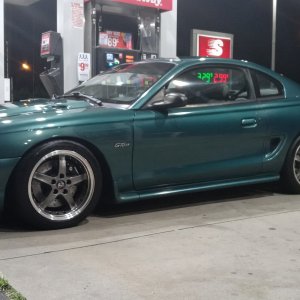
CompOrangeSN95
Well-Known Member
I asked in my build thread but I think that's dying haha Anyone know a good way to flare the end of 3" exhaust pipe?



mygreengt said:try a diesel exhaust store
AaRoN said:Is your engine N/A or FI?
AaRoN said:I ask because a 3" exhaust will do nothing but reduce exhaust scavenging and rob power.
MustangChris said:you can always weld in a washer somewhere in the middle ;-)

AaRoN said:I ask because a 3" exhaust will do nothing but reduce exhaust scavenging and rob power.
SVTurbo 98 said:AaRoN said:I ask because a 3" exhaust will do nothing but reduce exhaust scavenging and rob power.
Prove it.
SVTurbo 98 said:AaRoN said:I ask because a 3" exhaust will do nothing but reduce exhaust scavenging and rob power.
Prove it.
AaRoN said:SVTurbo 98 said:AaRoN said:I ask because a 3" exhaust will do nothing but reduce exhaust scavenging and rob power.
Prove it.
Sure thing:
First of all when it comes to modifying a car, bigger is not always better. In this case, it holds true to my point. Larger diameter exhaust piping does increase flow but decreases velocity. Velocity equals torque and flow equals horsepower (when speaking of induction and exhaust). Too large of an exhaust also reduces the scavenging effect. The general rule for a car with a 250-300 cu. in. engine making around 300HP (n/a) with dual exhaust should have a 2.5" exhaust for optimum performance and scavenging. When the piping is too big it also has more heat transfer. Meaning the exhaust gases are cooler, thus moving slower. This is the purpose of header wraps. The thermal barrier on the headers reduces the amount of escaping heat which speeds up the exhaust gases inside the header. Scavenging is important to help remove all exhaust gases from each cylinder. Without that, what's the point of the exhaust system?
SVTurbo 98 said:AaRoN said:SVTurbo 98 said:AaRoN said:I ask because a 3" exhaust will do nothing but reduce exhaust scavenging and rob power.
Prove it.
Sure thing:
First of all when it comes to modifying a car, bigger is not always better. In this case, it holds true to my point. Larger diameter exhaust piping does increase flow but decreases velocity. Velocity equals torque and flow equals horsepower (when speaking of induction and exhaust). Too large of an exhaust also reduces the scavenging effect. The general rule for a car with a 250-300 cu. in. engine making around 300HP (n/a) with dual exhaust should have a 2.5" exhaust for optimum performance and scavenging. When the piping is too big it also has more heat transfer. Meaning the exhaust gases are cooler, thus moving slower. This is the purpose of header wraps. The thermal barrier on the headers reduces the amount of escaping heat which speeds up the exhaust gases inside the header. Scavenging is important to help remove all exhaust gases from each cylinder. Without that, what's the point of the exhaust system?
Well you didn't really prove anything with that response but rather repeat what you've read on the web or read in a magazine. I was looking for tests that you have done (or someone else) that prove too big of an exhaust after the collector will hurt performance with tuning involved.
How exactly is velocity measured in an exhaust system?
What happens to exhaust gases as they cool down?
Where in the exhaust system do the gases cool down and is it farther down the system as you increase rpm?
Where is the pulse based exhaust scavenging concentrated at?
I'm really not trying to be an a*s i'm just looking for hard facts that support your claim...