
Electric power steering info

shovel

Active Member
Joined
Jan 4, 2023
Messages
545
Reaction score
521
I'm sharing this in case it helps someone else in the future.

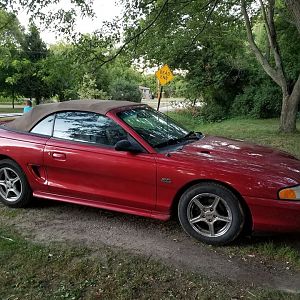
Before we get started I want to get two things out of the way: 1. this Mustang is a high mileage "rescue" so I'm not concerned with preserving its museum or collectible value. Its value is for me smiling while I rack up miles. 2. I am not good at welding, I need more practice and this is practice.

I chose a Volvo S40 power steering pump because these are massively available and it's a swap that's been done hundreds of times on vehicles of every make and model, so I didn't have to invent anything there.

These can be junkyarded or bought new from the usual alphabet soup overseas manufacturers pretty cheap.

I opted to get one that has the bracket included because that takes care of the rubber isolators and the basic shape of a bracket, so all I have to do is grind off paint and weld up random debris to fit my Mustang.
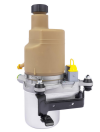

1780370843875.png

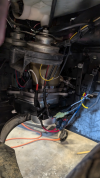
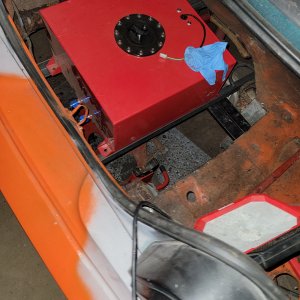
I have already relocated the battery to the trunk, so the area under the previous battery tray in front of the driver side front tire looks like as good a place as anywhere.

After lining up and measuring where I want it to sit I used a 2.75" hole saw to punch a hole in the metal below the battery tray:
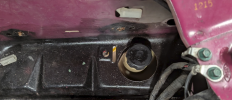
1780370973282.png

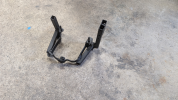
Here's the basic look of the bracket, I did end up further modifying it after this photo (spacer on left side, as viewed from this angle) but the idea is about the same, if you're copying my work you'll have to kinda do your own thing anyway. I believe in you.
1780371324651.png

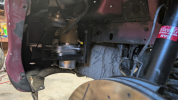
The left side of the bracket, viewed from this angle is the forward side of it and bolts to a pair of M8 rivnuts in the side of the radiator support loop. The right side of the bracket (vehicle rear) attaches to a single M8 rivnut mounted in the frame rail below the former battery tray. I had planned two but an inconvenient hole was already there from the factory. It feels quite rigid, the forward bolts against the radiator support do a good job of managing the vertical load so it is unlikely to vibrate or suffer under rough roads, pot-holes, etc.
1780371501465.png

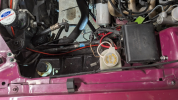
Note that I am in the middle of other work unrelated to the electrical power steering so the engine bay + wiring is very messy for now. I'll post cleaner finished photos when it's finished and cleaner.

Here is the position of the filler cap while mounted in its final, permanent location.
1780371714098.png
 
OP
OP
shovel

shovel

Active Member
Joined
Jan 4, 2023
Messages
545
Reaction score
521
As for the hydraulics, the factory SN95 high pressure hose does thread into the Volvo pump, I don't know if it would seal but it threads in - however there is not really any clean way to use the hose because of its length and the shape of the rigid end.

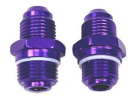
I opted to order a set of 6AN fittings for the rack -

1780372257317.png

and a similar 6AN fitting for the high pressure port of the pump. Then I'll figure out how long the hoses need to be and if they need 90 or 45 degree ends. To be determined.


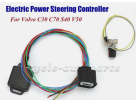
Electrically - it requires a lot of current. In the Volvo it was designed for the pump is commanded by the powertrain control module to run at different levels of boost so it draws as little as 15A and as much as 80A supposedly - but in our application there's not a simple way to tie it in to the vehicle speed sensor. Instead there are two options - either connect it straight to switched power and it runs in a fixed fail-safe mode supposedly around 70% max, drawing around 40-50A continuously or else connect it to a 3rd party control box with a knob and you can use the knob to dial in your preferred level of assist.

The controllers are about $60.

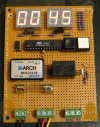
1780372664360.png

Because of the high current draw I wanted to make sure it would only run while the engine is actually running, turning the alternator. So I added an extra oil pressure switch that will complete a circuit only while the engine is generating oil pressure.

I have NOT completed the electrical hook-up yet because the pump needs power steering fluid in it first, it can be damaged by running dry. I'll post more once I have the install finished and can share what I learned in the process.

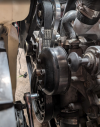
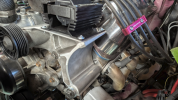
Another detail to mention is the bracket and pulley routing. I have deleted the secondary air pump and I am also converting to electric air conditioning. I've also relocated the alternator to a low position where the secondary air (smog) pump previously was located.

With the power steering pump + A/C compressor bracket removed there is nowhere to mount the ignition coil and also the belt does not wrap around the water pump very well.

This bracket from Speed Doctor relocates the alternator to a low position and adds an idler pulley. This allows a physically larger alternator to be used & avoid clearance problems with the valve covers on a 94/95.

1780373175882.png

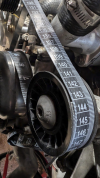
Unfortunately this results in very little wrap around the water pump and I don't trust it to turn the pump without slipping under all loads and temperatures and conditions.
1780373332295.png

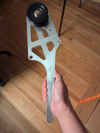
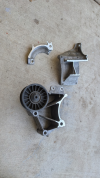
So as a solution I cut down the old power steering pump bracket:

1780373376862.png

This provides the place to mount the ignition coil (OE or aftermarket) and an idler pulley. The OE pulley is smooth (back of belt drive) but can be swapped out for a 6 rib idler. The axle bolt is right-handed so if the bearing seizes it might unscrew itself but you already got problems if that happens.

1780373471902.png

1780373523617.png
 
OP
OP
shovel

shovel

Active Member
Joined
Jan 4, 2023
Messages
545
Reaction score
521
For anyone who might be wondering why do this in the first place, I mostly just felt like it. Maybe it will end up being dumb, won't know until it's done.

The general idea is that it allows tunable steering feel and it decouples engine rpm from assist level. I assume the reduced rotating mass will make the engine feel more lively.
 

cobrajeff96

Well-Known Member
Joined
Feb 1, 2022
Messages
2,778
Reaction score
2,835
Location
Germany
One thing you might have to revisit is the relative assist to driving speed ratio. Some might be ok with constant effort level even at higher speeds. I myself prefer a stiffer wheel at higher speeds. Mostly a subjective assessment.

Keep us posted on your electric A/C goal, that sounds cool.
 
OP
OP
shovel

shovel

Active Member
Joined
Jan 4, 2023
Messages
545
Reaction score
521
The engine driven pump is presumably producing more boost at highway speed (2500+ engine rpm) than parking lot speed (barely over idle) so if anything a constant speed should be an improvement.

Since the engine controller doesn't have any idea what the car's road speed is there's not a good way to get commands from that and I'd rather not dig into the speedometer cluster just for this, so hopefully it's not difficult to find a single good setting that feels right to me and leave it there.

The control box has a potentiometer for user input, you just dial in your desired boost. I haven't checked its value but I expect it's 10k or 100k and that means with a little trial and error I can find some favorite settings, measure the value of the pot and then replace it with a resistor. That also means someone else who doesn't mind building a monster could use a GPS activated relay to switch between two different resistor values at a predetermined speed.

I'm better with a soldering iron than I am with a welder but I don't want to introduce that level of complexity

1780378327655.png

Electric A/C is coming after I finish making the car driveable.. just in time for the heat of summer.
 

cobrajeff96

Well-Known Member
Joined
Feb 1, 2022
Messages
2,778
Reaction score
2,835
Location
Germany
You can vary the output potentially quite easily. For instance, I've doubled the use of a Samoco T-56 Reverse Lockout Module from Wirebarn as an electronic parking brake failsafe (it activates only at very low speeds and de-activates right around 20mph from what I've observed during actual driving). The same speed sensor can tap into pretty much any SN95 transmission (just uses the gray and pink wires on the existing transmission speed sensor) and this way you don't have to reach for a dial or switch every time you pull up to the driveway or into a parking lot.

And there's loads of people on places like Adafruit and Sparkfun that have done mods like these. You can get crazy and go with Raspberry Pi if that's your thing, but it may be unnecessary.
 

Attachments

  • 20230520_164311.jpg
    20230520_164311.jpg
    151.9 KB · Views: 4

kas_lar

New Member
Joined
Sep 16, 2024
Messages
69
Reaction score
23
Great work, Shovel! I’m thinking about doing this upgrade as well.


My battery is still in the stock location, so I need to figure out where I could mount the Volvo pump without making the engine bay even more stupidly crowded than Ford already managed.


Do you have any other guides, photos, or links for this conversion? I’m especially interested in pump placement, wiring, fittings/hoses, and how people route everything with the stock battery location.
 
OP
OP
shovel

shovel

Active Member
Joined
Jan 4, 2023
Messages
545
Reaction score
521
I guess you could put the power steering pump in the back.. or there's room in front of the passenger side tire there just isn't really a way to access it to fill or inspect levels.
 

Latest posts

Forum statistics

Threads
78,527
Messages
1,535,647
Members
16,185
Latest member
dmen76

Members online

Top