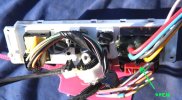
I looked up the diagrams in my 1997 EVTM manual and in HVAC details in the 1999-2004 PDF's I have, and they both show only 5 vacuum lines going to the HVAC controls - White, Red, Blue, Yellow, and Black. The 1999-2004 PDF's I have additionally document the 6th spot on the vacuum connector as "unused". So, it's intentionally empty, but that's all the manual says about it.
For reference:
- Black is the vacuum input from the engine compartment
- White controls the recirc door (vacuum turns on recirc mode)
- Yellow controls the defrost door (vacuum turns off defrost mode)
- Red and blue both control to the floor vs panel door, having two vacuum sources on this one allows the door to be halfway open for mix or all the way open for floor only mode (vacuum puts the door in either mix mode when blue alone one has vacuum, or full floor only mode when red and blue both have vacuum).
The 6th port could be an intentional bleed air port so that when vacuum is removed from one of colored vacuum lines there is a source of air into the now unused lines to let the vacuum motors go back to their "off" state. If the vacuum entering the open port increases when the air outlet knob is moved and slows down/stops when it's left alone, that would point to it being a controlled air bleed for unused vacuum doors.
If you plug the 6th port with a small vacuum cap, does the hiss go away? Does the system work correctly with the knobs in all positions if its capped off? It may stop working correctly when a cap is installed - if the vacuum doors are slow to change positions with that port capped or do not change like they should, it's very likely an air bleed. You may simply have a leak somewhere else, or the hvac controls are just leaky. Even new parts these days are not always good parts. :-(
If the hvac check valve, controls, and vacuum motors all have good seals, the vacuum level in the HVAC system should stay unchanged for a bit after the engine is shut off, at least if you don't touch the hvac controls. It will eventually leak down and not have a vacuum anymore, but I'd think it should take a few minutes at least. You could test this with a vacuum gauge after the check valve and get an idea of what size of leak there is, if any. If you have a small vacuum pump you could use that to run the HVAC system with the engine off and better listen for where the leak is. Vacuum motors can be heard, especially if your ears are sensitive to the noise they emit whem vacuum is applied/removed and the diaphram/linkage moves.
If the port is an air bleed and it's just noisy/annoying, consider adding a hose to it and routing it back up under the dash away from whst can be easily heard. It can still pull in air, but it won't be as close to your ears. You might be able to find a small filter to add to the end of it further muffle the sound.
Good luck. Small noises like a hiss can be infuriating to find and solve. Often once you hear the noise you can't "unhear" it. The HVAC doors in some of my cars are weirdly loud when you shut the car off and they return to their "off" position with a noticable squeaking noise. Once the engine is off and the car is quiet it's very noticable.