long term chassis development project

wash

New Member
Joined
Mar 22, 2013
Messages
41
Reaction score
1
Hi everybody.

I was planning on posting elsewhere but this forum's focus on the SN95 and lack of retarded user account requirements has steered me this way.

On to the project:

I want a car that will handle on the street or on the track. I can't justify a dedicated track car so a full cage is out but I do not require all the creature comforts and I do want to be safe so a custom roll bar, race seats and 5 point harnesses are part of the plan for my ~weekend toy.

Any way, through the floor subframe connectors were part of the plan until I did some research. It turns out that SFCs don't do much for torsional rigidity (resisting chassis twist), mostly they increase beam stiffness (resisting the chassis bending up or down in the middle). The way people increase chassis stiffness in first generation mustangs is rocker reinforcement and torque boxes to tie the rockers in to the cowl/front frame rails.

That makes sense from a structural standpoint because the section of the rocker can be taller than SFCs and being located farther from the chassis centerline moves the structure to where it can contribute the most to rigidity and it will increases the beam strength as much as SFCs or maybe more (due to the taller section).

I've got two inspirations for my tests, the first is the Mustangs Plus chassis stiffening kit which is essentially a weld on jacking rail, a convertible style inner rocker reinforcement and torque boxes (for first gen mustangs) and the second is an Agent 47 bolt in street cage for SN95s.

The Agent 47 kit used a bar that runs on top of the rocker which is a good idea except for the bolt in part.

I want to combine those ideas with a weld in jacking rail on the bottom of the rocker and a weld in side bar on the top. That will increase the section of the rocker a lot with only a slight increase in step over height.

I want to test it on my parts car chassis, before and after to record the increase of stiffness and make sure I get the details right before my keeper goes under the knife.

Details still up in the air are how to tie in to the cowl/front frame rails and how to tie in to the rear suspension mounting points.

With a weld in roll bar I'm planning a rear seat delete and maybe a race style three link with a long third link that ties in to the base of the main hoop.

Front suspension is probably even more ambitious but I'm going to worry about the chassis first.

Lastly I've heard that '98 or '99 Mustangs started using a structural expanding foam in the rockers to stiffen things up, if I can find some good tech for adding foam, that sounds like a good way to solidify things.

This is a long term project, expect progress to be slow.

I'm not building this for any rule book or racing class but if you see something that would get me kicked out of an open track day, HPDE, drag strip, etc. please let me know.

Here is a link to the Mustangs Plus chassis kit:

http://www.mustangsplus.com/tech/chassis/index.html

Here is an article on the Agent 47 cage:

http://www.mustang50magazine.com/techarticles/m5lp_0607_2003_mustang_cobra_rollcage/viewall.html

 

KillNThrill24

Legend
Joined
Apr 16, 2012
Messages
7,502
Reaction score
449
Location
Cleveland Ohio
Well first off welcome to the forum man! This is a great place to be, the level of D-bagness here is far less than that of those "other" sites. Judging by your post I'm going to guess your in an SN yourself? Well your keeper car anyway?

Sounds like you've done your homework on your chassis man, it does really make sense that a SFC wouldn't do a whole lot, I often wondered myself what good it would do running longways on the car anyway's.. I personally always thought they should cross, I think that would accomplish a lot more in reducing the chassis twist that a bar running longways. But I never really thought to much about it

I like the ideas you've got going so far tho man, be sure to keep us posted on what else you come across, and then of course what you plan on doing. You should also post up some pix! I like the idea behind your build tho, track ready, yet streetable. That's exactly how I would like my car built in the end!
 
OP
OP
W

wash

New Member
Joined
Mar 22, 2013
Messages
41
Reaction score
1
Nothing worthy of pictures yet.

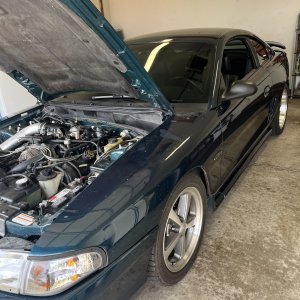
My parts car/test mule is a '95 GT and my keeper is a '94 Cobra which I got for a song because the front is crunched a bit.

The plan is to figure out all the chassis work and "fix" the Cobra in one step along with some rally car style seam welding, undercoating removal and engine bay cleanup.

An X is a good idea but I don't think there is room to do it right.

I probably will do some seat mount bracing under the floor to make it a truss section tied back in to the transmission cross member/main hoop/third link mount area.
 
OP
OP
W

wash

New Member
Joined
Mar 22, 2013
Messages
41
Reaction score
1
Reading some of the other threads I've seen a lot of dress-up, concerns about window tint and heavily lowered cars with stock suspension.

My car is not going to be like that, I want as much of a sleeper as you can make with a Cobra.

The first reason is that I'm not too flashy.

The second reason is police profiling. Its not supposed to exist but you can get away with a lot more driving a brown Honda minivan than a red Mustang with a JC Whitney wing bolted to the trunk. In that respect a Cobra isn't the best place to start but an old Cobra that isn't known for being terribly fast is not too bad, especially since it is white.
 

Steven

Legend
Joined
Jun 3, 2007
Messages
8,138
Reaction score
123
Location
SC
It happens. Welcome aboard. Everyone has their particular taste in cars. You'll find that their is a decent mix of different on this forum if you look hard enough. On average the cars run similar to each other
 

RichV

Well-Known Member
Joined
May 6, 2012
Messages
4,230
Reaction score
254
Location
CO
Welcome!

That's a lot of brain damage and work. I can tell you I don't have half that hardware for my race class and I can run with a lot of Jap and Euro-trash out there.

what exactly are you shooting for to compare with? Not being a hardass, just curious.
 

Slykin

Well-Known Member
Joined
Jul 11, 2009
Messages
3,538
Reaction score
118
Location
Tyler, Texas
More than through floor subframes and SFC's is not necessary IMO. Those alone give plenty of rigidity not to mention that Griggs nor MM feel that it's necessary to run more. Give MM or Griggs a call and see what math they throw your way. I'd be interested to see it.
 
OP
OP
W

wash

New Member
Joined
Mar 22, 2013
Messages
41
Reaction score
1
Well my goal is to get to the 80's supercar standard, 300 kph top speed, 0-100 kph around 4 seconds, around 1g lateral grip, good brakes, all motor, no power adder.

Safety is a concern but no bolt in junk. While I'm welding on my car I might as well make it stiff because as much of an improvement an SN95 is over a Fox body, its still pretty flexible which makes you have to run stiffer springs which leads to a harsh ride.

I don't like the limitations that most race classes have because I don't think I could make a competitive car that I would like to drive on the street.

I can be bad about leaving things undone. I'll never regret adding 50 lbs of extra steel if my chassis stiffness increases by 50%. I know I'll regret putting together my Cobra if I don't investigate the chassis first because I'll miss the opportunity to optimize my rear suspension unless I tear down the entire car again.
 
OP
OP
W

wash

New Member
Joined
Mar 22, 2013
Messages
41
Reaction score
1
For my math I get out my copy of Race Car Vehicle Dynamics and a big stack of scratch paper.

Most street car chassis are nowhere near the rigidity of a carbon fiber monocoque race car chassis but I guarantee F1 car designers are not satisfied.

Without the strict weight constraints of F1 and the ability to prototype in steel rather than FEA simulations, my bang for the buck will be much greater than an F1 team could hope for.
 

RichV

Well-Known Member
Joined
May 6, 2012
Messages
4,230
Reaction score
254
Location
CO
Yea, that's a lot to be desired from this 70's Fairmont chassis. Not sure how much track experience you have, I'm guessing prolly not much since you're comparing F1 to SN95, lol.

What I've learned through my years of open tracking is get a set of sticky tires and take the the car on a road course and notice where it needs help. Like when you come up on a tight corner at 100mph+ and your ass end does a little wiggle under braking, those would be the LCAs ready for replacement. When you get a ton of understeer, but only in a certain part of only some turns, those would be your FCA bushings being real soft, then when your steering wheel is continualy see-sawing, that would be rack bushings wobbling around. Bad shocks and struts will cause the car to be unstable in a lot of areas in addition to the above. My chassis is all tied together with a 6 point road cage, which you do not want in a street car. The SN's chassis is miles ahead of the Foxes, filling the box channels with spray foam seems rediculous, if anything it would be to quiet things down, but like I said, this chassis compared to a Fox is much stiffer. The metal is thicker and the welds seem much more solid. Welding more bars everywhere will not make this chassis better, there is still a lot to be desired in the general design of the suspension. The SNs are very capable out of the box with simple aftermarket parts, will it achieve the 80's supercar standards, I have no idea. But there is not a practical reason for it, now lets hit the race track!!
 
OP
OP
W

wash

New Member
Joined
Mar 22, 2013
Messages
41
Reaction score
1
As for the foam, Ford did it and some Japanese manufactures do it too. It might be an afterthought or a quick fix if they don't want to re-tool but evidently it works and being foam it probably doesn't weigh too much. It makes sense from a torsional standpoint, the rockers are not seamless round tube so they don't transform twisting loads in to pure shear stress on the surface.

I don't have track experience but since my car will mainly be used on the street, I don't think that is very relevant.

I do have experience cutting a race car in half and welding it back together again, I think that is a lot more relevant.

I have driven enough cars on the street to tell that my Mustang could stand to be stiffer and I've never heard anyone say a stiff car is slower than a flexible car.

I'm going to be working on the chassis and I want to make sure it is as good as I can make it before I touch up the paint and reinstall all of the flammable things that you take out for welding.

I know chassis stiffening isn't relevant to some kinds of racing because its against the rules and that is why I'm not building for any racing class. I want it my way, not pushed to some funky configuration for points or de-tuning my engine to make a power to weight ratio.
 

RichV

Well-Known Member
Joined
May 6, 2012
Messages
4,230
Reaction score
254
Location
CO
There are a bunch of classes out there, and a lot of classes are not limited to anything. NASA's PT (Performance Touring) allows you to go nuts with modifications. American Iron Extreme is anything goes as well. Now you're competing with some HUGE checkbooks. But there is allways a class to race in, if that's what you want to do.

If you want to bolt all these 'race car parts' and chassis aids and go to Burger King and car shows it's a waste of time and money IMO. But I will say that I thought my 85 SVO was god's-gift to Mustang handling before I started open tracking, because of all that I had read and all the SVO people's big egos. My 1st race car I built was a E30 BMW, all stock with street tires, the chassis was so stiff you could jack in the front or rear of the car and 2 wheels came up almost immediately. Try that in a Fox or a SN without a cage, ain't happening. So you can definitely feel the difference of a stiff chassis, and on a road course it's amazing what a difference it makes.
 
OP
OP
W

wash

New Member
Joined
Mar 22, 2013
Messages
41
Reaction score
1
I guess I'm lucky that I don't feel some overwhelming urge to go fender to fender because if I build what I want I'm sure I would have to go up against dedicated track cars that start with better engines, chassis, suspension, aerodynamics, etc.

I'm not going to travel enough to win anything significant even if I had a competitive car and enough driving skill so HPDEs, open track days and twisty roads are what I'll build for.

I might try an open road race in one of the slower speed classes, maybe 140?
 

RichV

Well-Known Member
Joined
May 6, 2012
Messages
4,230
Reaction score
254
Location
CO
Yea, that's the benefit of a 'spec' class, where modifications are limited. When you go to a open class, the big dogs with huge checkbooks stomp the little guy 9 out of 10 times.

The other thing that I have heard of guys doing to stiffen chassis is seam welding. This is not legal in my race class, but it seems to make sense. Weld or stich-weld all the structurual seams in the unibody, therefore strengthening everything as one unit.
 

Burninrock24

Active Member
Joined
Mar 19, 2013
Messages
644
Reaction score
71
Location
Minneapolis, MN
Great post, good to see another DIYer on here, but the truth of the matter is that anything beyond the top level system devised by Griggs racing: http://www.griggsracing.com/product_info.php?cPath=4332_4310_4347_1060&products_id=535 is overkill. Aka, seam welding and stuff like that is unnecessary. Especially on a street car.

You said that you don't haven't spent time on a track, I'd strongly suggest you do that before you go crazy with your chassis and suspension first. There's no sense in 'fixing' certain ride characteristics if you don't know what to look for.

Check out my post in the Road Racing section for more info on suspension/chassis tuning: http://sn95forums.com/showthread.ph...metry-for-road-racing-And-which-parts-do-what

If you really want your car to be the biggest sleeper out there, you need to do a driver mod. And there's no real way that you'll become a great driver (responsibly) without getting on a closed course. Even if it's just spending hours on an autocross lot.

Many times creating an overly aggressive suspension set-up will hurt the average drivers abilities. They allow for maximum grip, but once you go beyond that point of max grip they become very unpredictable and unstable. Just food for thought.
 
OP
OP
W

wash

New Member
Joined
Mar 22, 2013
Messages
41
Reaction score
1
Well Griggs kits feature a torque arm rear suspension so they are already less than ideal.

Their main virtue is not being a quadra-bind.

I don't know enough about the Griggs SLA but my gut feeling is that it is less than ideal.

Once again, its hard to do worse than Macferson struts.

For a kit designed to re-use a lot of parts and install easily, its not too bad. I want to spend time on prep, move pickup points if it makes sense (3 link) and use some non-mustang specific parts.

Doing the design and fabrication myself I might even save money in a bargain that includes better geometry, less unsprung weight, increased durability and maybe a wider range of adjustments.

I think I'm going to do it my way.
 

Burninrock24

Active Member
Joined
Mar 19, 2013
Messages
644
Reaction score
71
Location
Minneapolis, MN
I understand your concerns and doubts about the Griggs system, but it is literally the best engineered suspension system for SN95 Mustangs. He claims he has yet to be beat by any Ferrari in his class. In any case, the differences you are talking about here are so minute that it more than likely won't be worth the extra time and effort and possible risk of ruining parts of your chassis to gain marginal benefits.

What I'm saying is that unless you have a lot of disposable income and a lot of disposable time, then stick to the tried and true methods. Especially with chassis work.

And in any case, you aren't going to notice a worthwhile difference if you aren't familiar with high performance driving. Your time would be better spent working on heel-toe, corner entry/exit, throttle lift control, and general driving before I would start ripping apart your chassis.

I'm sorry it sounds harsh but it's the truth. There are people in my class that try every trick in the book, but the fact of the matter is that a better driver will win nearly every time.
 
OP
OP
W

wash

New Member
Joined
Mar 22, 2013
Messages
41
Reaction score
1
I know I won't ruin anything because I'm going to use a test mule.

It won't be expensive because steel is cheap.

It will take time but that's how I want to spend my time.

I expect seam welding to show a small increase in rigidity for a miniscule weight increase, the rockers with weld on jacking rails and an upper extension might not show a huge increase until I add reinforcement to tie the rockers in to the cowl/front frame rails and rear suspension pickup points. After that and a k-member brace, I think it will be difficult to find much improvement without adding a lot more structure so its all about finding the best balance. Once I find that balance, I'll remove any dead weight I can find and try the foam just to see how much it can do. After all that I'll do it again on my keeper and scrap the mule.

Hopefully the result will be a description of what works to stiffen an SN95, how much it weighs and good deflection figures so that the next time someone asks how to stiffen their chassis anyone who has read the thread will be able to say xyz reduces chassis deflection by n% and Griggs does??? (Note the ambiguity there)
 

Burninrock24

Active Member
Joined
Mar 19, 2013
Messages
644
Reaction score
71
Location
Minneapolis, MN
Well I mean if you're willing to put the time in, then more power to you! But what I'm understanding is that a lot of areas you're correcting aren't the main causes for chassis deflection. Look at it in a hypothetical percentage way, chassis stiffness only accounts for say 35% of your handling capability, the rest comes from proper geometry, control arms, spring rates, ride height, tire pressures, etc. So by seam welding and spraying expanding foam will improve chassis rigidity by even 2%, then you're only improving your overall handling capability by 0.7%

Your biggest gains in chassis rigidity will come from upper and lower welded subframe connectors and fortifying the torque box.

And even then, you could achieve much more rigidity by welding in a tubular roll cage or pre-loading a shock tower brace and welding that in place.

Any sources of other people using this foam? Or any other methods you've mentioned? Just keep in mind that every time you drill a hole or make a cut in the existing frame you risk weakening the overall structure.

Also, how do you plan on measuring chassis deflection?
 

Latest posts

Forum statistics

Threads
78,528
Messages
1,535,656
Members
16,185
Latest member
dmen76

Members online

Top