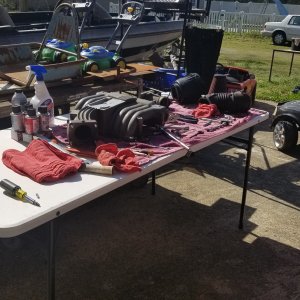
Updating the acumulators and removing the springs will work wonder's for your shift's. Exactly how inclined are you to taking your valvebody off and drilling holes in it?
A torque converter convert's torque.... Into yummy cotton candy :2funny: Ok, no, it is a hydraulic coupling, it allows for some slippage when you start off, like a clutch you don't have to work.
I tell people to think about torque converters like two fan's facing each other. If you turn fan #1 on (this will be the engine side from now on) and leave Fan #2 (trans side) off, slowly but surely, fan 2, even though it isn't running, will start to spin, fast and faster, until it is going the same speed as fan 1. The speed where that happens is your stall speed. And just like fans, it is determined by the pitch of, and how close together the blades in your converter are.
People who have swapped in longer duration camshafts, will tend to make power a little higher (or alot higher) in the rpm range. This happens at the expense of low rpm power. So if you have a cam that makes little to no power at 2000 rpm, but you've already hit your converter's stall speed by then, acceleration and driveability will suffer. A swap to a converter with a stall of say, 300 rpm, will allow the engine to move into it's powerband easier, kind of like slipping the clutch moe in a manual car.
Hope that helps, lemme know if you wanna get into the gut's of your trans, because transgo sucks, but I can point you in the right direction if you ain't afraid to drill.







![IMG_20140524_152057360_HDR[1]](/data/xfmg/thumbnail/0/66-1b90088565df25d76ff5bd73b7f47142.jpg?1623783787)